
Molecular cars
Model cars are an essential child’s toy, but chemists can also have fun with miniscule ‘molecular cars’ as part of their research. During his interview with Chemistry Review, 2016 Nobel prizewinner, Professor Ben Feringa, talked about his molecular car:
“It’s a four-wheel drive car. We built it in a 7-year exercise, simply because we had this rotary motor and we wanted to prove that you could turn rotational motion into translational motion. It took a long time, but we could indeed see it take steps along a surface, which proved that we could convert rotation to translation.”
How does it work?
Feringa’s research group made the molecular car during their investigation into molecular motors, molecules that rotate in a defined direction controlled by a stimulus, in this case light. Each wheel is a rotary motor and rotates in a defined direction (illustrated by the arrows in Figure 1) to propel the car in a ‘stepping’ motion across a metal surface. The direction of rotation is defined by the motor’s chirality (mirror image versions of a chiral molecule cannot be superimposed upon each other).
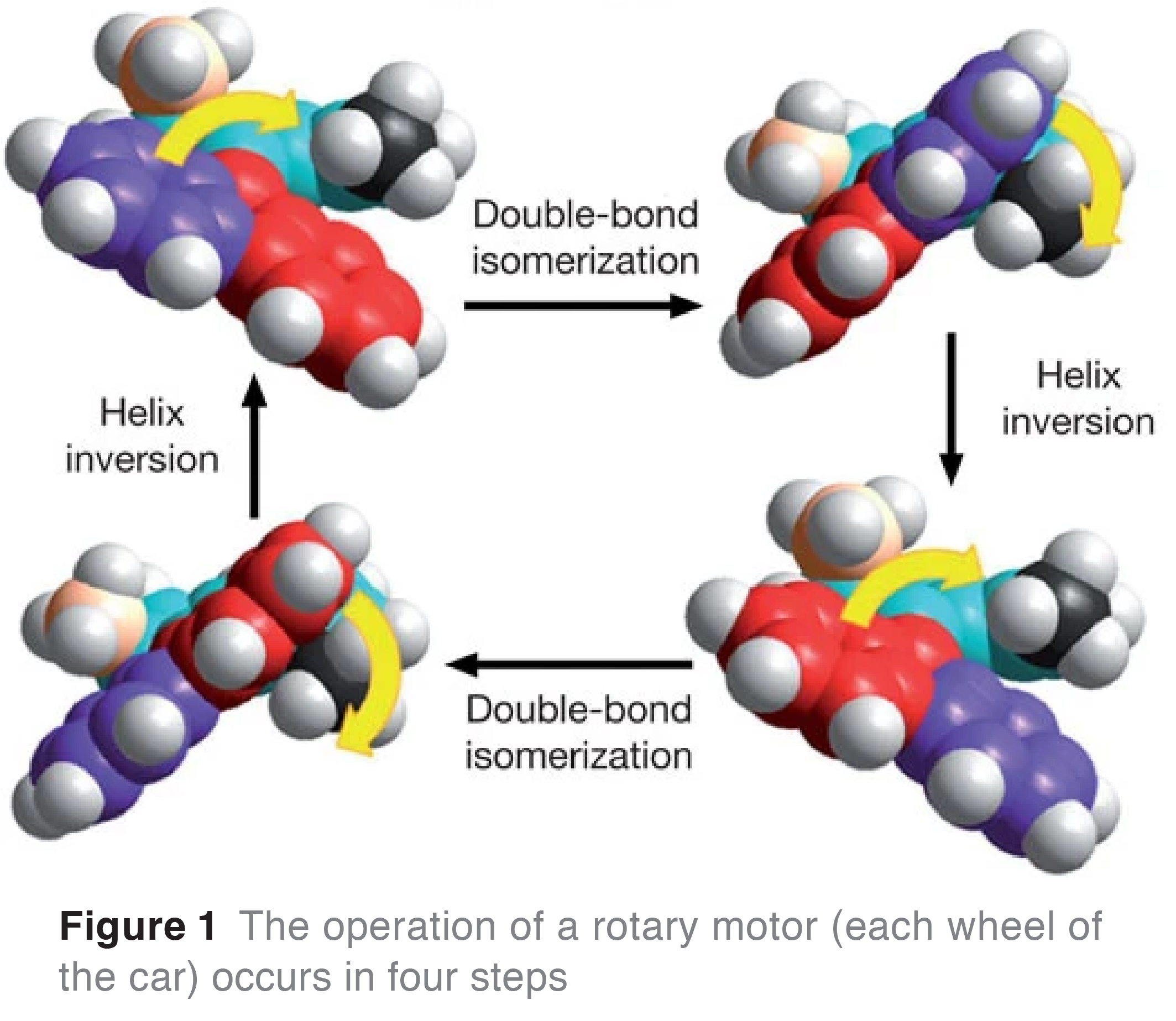
For the wheel to turn, a rotation must occur around a double bond. This movement is cumbersome and is why light energy is required. This step is the slowest, as the double bond must break, rotate and reform. Helix inversion is a very quick step and requires very little energy compared to the double bond isomerisation. A second pulse of light then supplies the required energy for the rest of the movement. The whole rotation can be viewed as two steps, each with an overall rotation of 180°. The light energy, usually in the ultraviolet part of the spectrum, is sent in rapid pulses, effectively fuelling the car. The four individual rotational motors interact with the surface of a metal to produce translational motion, driving the car along. Ten ‘steps’ taken by the car corresponds to an average distance of 6 nm (6 × 10⁻⁶ m), which is equivalent to driving across three DNA molecules laid side by side. This is truly nanoscale transport in a molecular world.
Further Reading
If you enjoyed this article, make sure to read “Interview with Nobel prizewinner Bernard Feringa”.
Feringa’s article Electrically driven directional motion of a four-wheeled molecule on a metal surface is available to read at Nature.